ISU Extension Franklin County hosts informative session on Emerald Ash Borer
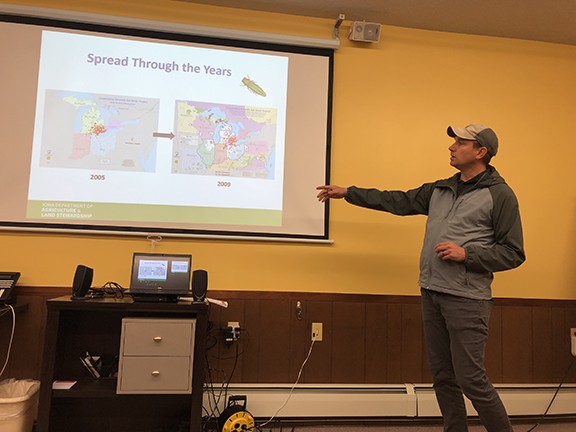
Mike Kintner, entomologist with the Iowa Department of Agriculture and Land Stewardship, speaks about the spread of the emerald ash borer at an informative presentation regarding the pest’s arrival in Franklin County. GREG FORBES/HAMPTON CHRONICLE
With one of the country’s most notorious pests found in the area, area residents learned more about its habits and how to protect their trees.
Earlier this year, experts confirmed the arrival of the emerald ash borer in Franklin County. Franklin County joined dozens of counties in Iowa to host the beetle that has wreaked havoc on ash trees in 34 other states in the country.
Representatives from the Iowa Department of Natural Resources, Iowa State University, the Iowa Department of Ag and Land Stewardship and the City of Hampton last Wednesday hosted an informational session about the bug, its habits, what can be done to prevent the loss of trees and how to compensate for the inevitable death and removal of trees.
Donald Lewis, professor of entomology with Iowa State University, said people with ash trees on their property have three options to combat the beetle. The first, he said, is to wait and see what hap-pens.
The second is to take down an ash tree now and replace it with a different species. Diversity, he said, is the best safeguard against tree disease because it helps prevent massive species loss.
“Do an inventory of what people have, what’s already in your neighborhood and you plant something else,” he said, adding that this method will also lessen the financial impact of the EAB’s damage. “Taking down ash trees now will spread out the cost of removal and replacement. If all the ash trees die at once, some of our towns will go bankrupt trying to keep up with all the dead ash trees.”
He said preemptive removal of a tree should especially be considered if the tree has sustained structural damage, is beginning to die or is showing signs of disease.
The third option, he said, is to treat a tree. Treatments vary in price and effectiveness depending on tree size. A do-it-yourself treatment is available at lawn and garden departments but trees must have a trunk diameter of 20 inches or less. Bigger trees will need a tree injection done by a professional.
Lewis emphasized that if a tree is treated, it needs to be done every other year in April to mid-May. Preventative treatments are encouraged when the EAB is confirmed 15 miles away.
He added that treatments need to be done with caution because the insecticides used are toxic to honey bees.
One of the most important steps when planning what to do with an ash tree is to simply identify if a tree is an ash tree or not. After that, a homeowner is advised to start looking for potential signs of an infestation.
Mike Kintner, entomologist with the Iowa Department of Agriculture and Land Stewardship said that the common signs of an infestation include upper canopy dieback and student leaves.
“Emerald ash borers like to attack the up portion first where they can bask in the sun and as tissue dies, they move down,” he said.
He said to look for splitting bark, D-shaped exit holes and s-shaped galleries under bark has tell-tale signs of an infestation as well. He added that the ash borer is the only pest that attacks trees to leave s-shaped galleries. A high activity rate of woodpeckers on ash trees is a good indicator as well, as the birds enjoy eating the insects.
As people begin to remove ash trees either due to an infestation or as prevention, they are encouraged to plant a varied species of tree to pre-vent another widespread case of tree loss and to make up for the loss of trees. Joe Her-ring, district forester with the Iowa Department of Natural Resources, provided tips when replacing trees. Diversi-ty, in both age and species, he said, is key when planting new.
“Of all the community tree inventories we’ve done throughout the state over the year, the data keeps coming back that 75 percent of all trees in the town are in an older, bigger size class,” he said. “From my standpoint, we’re not planting enough youthful trees when those old trees do die.
“We just need to keep planting more trees,” he added. “There’s always room for diversity and doing good cultural management and maintenance. If we put the right tree in the right soil, we alleviate a lot of the disease and insect issues.”
He said that the rule of thumb is to have no more than 20 percent of a community's whole tree population in any one genus, such as oak or ash, and no more than 10 percent in one species.
As far as what species of trees, Herring said to do homework. Knowing the soil of the area is important in determining what species will thrive will.
“One tip I’ve offered is to dig a test hole and feel the soil,” he said. “If you feel any sandy grittiness, you’ve got a well-drained soil and you can plant about any kind of tree on our list here and get away with it. If that water sits and ponds for hours, you’re going to have to narrow down your selection.”
In heavier clay-like or wet soil, for example, he said swamp white oak, hackberry and honey locust trees would thrive.
Location, he said, is also important when planting trees. “What I’m talking about is how beat up is that tree going to get from the wind, the heat and sunshine,” he said. “Those hot winds will dry out leaves and needles if you try to plant certain trees and evergreens.”
Category:

Hampton Chronicle
1509 4th St NE
Hampton, IA 50441
Phone: 641-456-5656
Email: news@HamptonChronicle.com
OnTheGoMedia