Iowa high schools are laying the groundwork for esport leagues
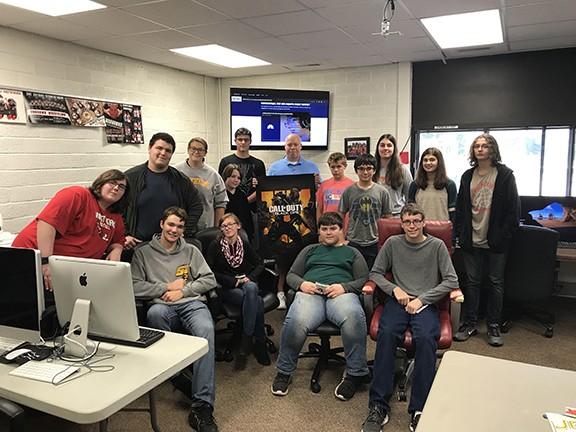
The West Fork esports team is one of the handful of teams helping develop a statewide high school esports association. Riley Rochelau, Vincent Otero, Rose Rother, Kyle Crum, Carter Hermann, Coach Eric Burt, Jacob Swenson, Hunter Lane, Allison Pitzenberger, Alex Suntken, Alan Nieuwboer, Carter Koop, Tianna Reason, Jacob Lewis, and Tanner Russell are among the West Fork Warhawks working to get the program off the ground. TRAVIS FISCHER/HAMPTON CHRONICLE
High school students across the state may soon have a new school activity to join as a team of Iowa educators work to develop the Iowa High School Esports Association.
Over the last several years the popularity of esports has grown exponentially. Fans pack stadiums while millions more watch online to see professional teams compete in games like "DOTA 2," "Rainbow Six: Siege," and "Fortnite" for multi-million-dollar prize pools.
Nearly 100 million unique viewers tuned in for the finals of the "League of Legends" World Championship last November, a viewership achievement that rivals that of the Super Bowl.
All of this attention and money has turned esports into big business. Between endorsement deals and exclusive streaming agreements, the top players of some of the world's most popular video games are becoming entertainment commodities similar to NBA and NFL stars.
Like professional athletics, esports are making their way to the college level. Dozens of U.S. colleges are offering scholarships for gamers as they develop their own competitive scenes, leading to interest in similar programs at the high school level.
Development of the IaHSEA began last year as Alene Vandermyde, a science teacher at Davenport Central High School, sent out an e-mail to as many Iowa high school athletic directors she could find about starting an esports league to compliment the traditional athletic leagues.
While relatively few athletic directors responded, Vandermyde's e-mail got forwarded to many of Iowa's high school technology directors, who were more inclined to participate.
"The people that responded kind of became the planning team," said Vandermyde.
Meeting weekly during the planning season, the educators combined their knowledge of both technology and high school athletics to hash out a plan to build an esports league into something that could one day be comparable to physical sports.
Davenport Central, West Fork, Osage, Dike New-Hartford, St. Ansgar, Mt. Vernon, WACO, and Fairfield are the eight schools participating in the group's initial test-run of an esports season.
Modeled the same way as traditional athletics, schools with enough students have varsity and JV teams and spend their free time practicing and competing with each other. Students are held to the same standards as any other activity, which means maintaining their grades and acting appropriately both on and off the playing field, even if in this case the playing field is a computer lab.
Right now, the IaHSEA is in the midst of wrapping up their first beta test season with the eight schools competing across two different games, "Overwatch" and "Super Smash Bros. Ultimate."
"We deliberately picked games that were very different," said Alene Vandermyde.
"Overwatch" is a team-based first person shooter developed by Blizzard Entertainment where each side selects a team of six unique characters to fight over a variety of objectives.
Meanwhile, "Super Smash Bros. Ultimate," developed by Nintendo," is a fighting game where players choose from a roster of popular video game characters across the industry to force each other out of the fighting stage.
While the Super Smash Bros. series of fighting games was designed to be a frantic multiplayer party game, a competitive scene has developed out of the game's 1v1 options. Under the IaHSEA ruleset, each school selects a team of five players who face their opponents in 1v1 contests in succession.
Structured similarly to traditional athletic seasons, the various esport teams have been playing each other in a round robin format for the last five weeks to determine their placement in the upcoming finals tournament.
Once the fall beta season has wrapped up, Vandermyde will gather feedback from the planning team and apply it to the next stage: A spring season featuring two different games and more involved school districts.
"I kind of foresee that doubling happening as we roll out," said Vandermyde. "We want to grow, but we don't want to grow too fast."
Ultimately, Vandermyde hopes to see the esports program grow to support a fall, winter, and spring season, with different games played throughout the year. There could be "Overwatch" in the fall, "Rocket League" in the winter, and "League of Legends" in the spring, much in the same way football, basketball, and baseball are spread out across the school year.
That vision is still quite a way off though. While Vandermyde eventually plans to have the program sanctioned by the Iowa High School Athletic Association, there are still several logistical hurdles to be overcome before they are ready.
Right now, the biggest logistical challenge to be tackled is score reporting. Informal reporting by coaches via e-mail may work when there are only eight teams to keep track of, but a formal system will need to be developed before too many additional schools join the program.
As for schools themselves, developing an esports program from scratch has its own difficulties.
"As with all things in school, money is the biggest challenge," said Vandermyde. "You're trying to find the same amount of financial space as everybody else."
Like any athletics program, an esports team needs specific equipment. For football this means pads, helmets, and balls. For "Overwatch" it means that every player on a team needs a copy of the game. While many of the students may already have their own accounts and gaming systems to practice on, schools cannot depend on passing that expense on to the players.
"We're very committed to try and stay as free as possible," said Vandermyde. "Even if we pick free-to-play games, you still need a computer to run them and that has to come from somewhere."
Instead of numbered jerseys, players on the Davenport Central "Overwatch" team are assigned a school-owned account for the game, which they are responsible for throughout the season. This not only gives the school ultimate authority over the player's conduct while using the account, but gives the player something they can build on during their high school esports career. Returning players for next year will get the opportunity to reclaim their school owned accounts, retaining any skins or emotes they've unlocked during the previous season.
"It creates a good motivation for returning players," said Vandermyde. Another challenge facing the program is that the relative newness of it all makes coaching somewhat different than traditional sports. Unlike games like football and basketball, where there are decades of tactics, strategies, and training methods to draw on, "Overwatch" has only existed since 2016 and has a metagame that constantly changes as Blizzard Entertainment regularly updates the mechanics of the game with new characters and abilities.
The coaches of an esports team won't have a lifetime of familiarity with any particular game to draw from, so while basic coaching methods like watching replays of past games to see where improvements can be made still work, the coaches may need to learn the nuances of a game on-the-fly from season to season.
"The kids are pretty good about self-coaching. Communication is the biggest thing with them," said Vandermyde. "We do a lot of work talking about metas and comps and how to counter things."
More so than traditional athletics perhaps, the esports league depends a lot on students to take the lead as the program develops.
"It's been interesting. Getting the actual team figured out was a challenge," said Carter Koop, a sophomore at West Fork High School and unofficial captain of the district's "Super Smash Bros. Ultimate" team.
Like any team captain, Koop helps keep his team organized and works to develop strategies to overcome opposing schools. In the case of "Super Smash Bros. Ultimate," this means tactically arranging the five-person roster for a match.
Also like any sport, while not every player on a team will always get a chance to compete, players are still treated as part of the team and encouraged to keep improving for the next season.
"I think it's really cool. It gives people more opportunities to do something in school," said Hunter Lane, a freshman at West Fork High School. "This is something I think I can be decent at because I'm not very good at sports."
Lane is among more than a dozen West Fork students that spend their free period during lunch playing "Super Smash Bros. Ultimate" in technology director Eric Burt's computer-filled classroom. Like most of his teammates, Lane does not participate in any of the traditional athletic programs offered by the district. Participating in the school's esports team is a way to be engaged in a school activity more suited to his interests.
This inclusion of otherwise disengaged students is a large part of why the esports league has been developed.
"Our whole goal is to get as many kids involved as possible," said Burt. "I think when you have more kids involved in activities, it makes school more fun."
As a technology director with a background in coaching, Burt immediately saw the potential in developing an esports program and was eager to jump on-board.
"Last year there were $17 million in esports scholarships given out," said Burt. "This could be a ticket to play esports at a college for free."
Both Burt and his students hope to one day see the esports program grow into a fully fledged spectator sport but recognize there is a long way to go before that happens. Right now the team plays their games in Burt's computer lab, which is functional for practice but doesn't accommodate a very large audience, though he says anybody is free to spectate if they wish.
One day Burt hopes that the West Fork esports team will be able to play their matches on the school's stage or gymnasium where their gameplay can be projected on a large screen for an audience to watch.
"You want these kids to be able to play in front of their peers and their parents," said Burt.
In the meantime, Burt says he is very appreciative of the support that the school district has given him as this program gets off the ground.
"I think it's exciting," said West Fork Principal Bobby Willms. "It's neat to be one of the leaders of this, and Mr. Burt has done a nice job getting things started."
Category:

Hampton Chronicle
1509 4th St NE
Hampton, IA 50441
Phone: 641-456-5656
Email: news@HamptonChronicle.com
OnTheGoMedia