Franklin County Sheriff gives insights on how to safely navigate harvest traffic
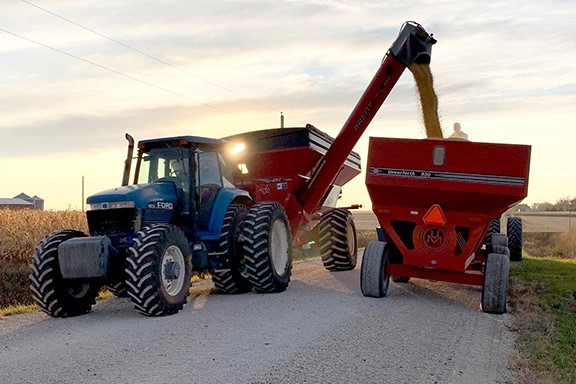
A farmer uses the gravel road beside his field to transfer soybeans from a chase cart to his grain wagons last year, after the wet conditions of 2019 caused the machinery to get stuck in the field. The Franklin County Sheriff warns motorists to be cautious when travelling during harvest season. FILE PHOTO
An early harvest thanks to a drought and storm damage in some areas mean motorists may soon notice an increase in agricultural implements on the roads.
Franklin County Sheriff Aaron Dodd said several factors exist when navigating roads during late summer and the harvest season. The most prominent, he said, is the presence of combines and other farm machinery on roadways.
When approaching equipment, Dodd said motorists in normal vehicles should keep a safe distance and use extreme caution if attempting to pass.
“Always be anticipating that farm machinery to turn left and when you’re passing, make sure you know if there is a possibility of them taking a left hand turn,” he said. “You can’t always just sneak right around them.”
He added that motorists must remember that usual passing rules apply when overtaking a piece of farm machinery and road markings are still enforced.
When passing and approaching equipment from the opposite direction, Dodd said motorists must also keep in mind the size of machinery.
“There’s no special rules for that other than they need to try to maintain their lane the best they can but lots of times, that’s impossible and they’ll have to take more than one lane,” he said.
Equipment operators, too, must be mindful of regulations in place for equipment. Dodd said all equipment must be fixed with a slow moving vehicle sign and at least one amber flashing light. However, Dodd said most modern equipment comes equipped with multiple lights and signals – more than are required by law.
“Most have multiple lights and lighting does continue to improve on equipment,” he said.
When machines begin hitting the fields, Dodd said other hazards not normally seen throughout the rest of the year will begin to present themselves. The first, he said, is increased dust on gravel roadways, especially given the recent dry stretch in the area.
“As dry as it had been prior to last week, dust is the biggest concern,” he said.
Traversing gravel roads, in general, he said, is a process that requires acute awareness given the tendency for gravel to be loose, the narrowness of some roads and the presence of unmarked intersections.
“Look out for hazards and if you have to swerve for an animal or farm machinery, be careful on a gravel road,” he said. “I would never recommend trying to overtake or pass something on a gravel road because you don’t have the benefit of someone trying to stay on the middle line and most of the time, there’s no distinct line.”
Another factor the harvest creates, Dodd said, is the increased presence of deer at dawn and dusk, as they’re forced out of fields as machines operate and as the fall rut begins.
“There have already been a few more deer out and about and we’re still a month away (from the rut), but they’ll get really active here in the next month,” he said. “In general, deer are a problem but they’ll really start to get flushed out.”
Category:

Hampton Chronicle
1509 4th St NE
Hampton, IA 50441
Phone: 641-456-5656
Email: news@HamptonChronicle.com
OnTheGoMedia